An Organisation Culture Audit with Sustainability in mind

An Organisation Culture Audit with sustainability in mind moves beyond traditional culture or compliance checks. It examines how deeply environmental, social, and governance (ESG) principles are embedded in the organization's core beliefs, behaviors, and decision-making processes.
Here are the main points to consider, structured for a comprehensive audit:
1. Foundational & Strategic Alignment
-
Stated vs. Lived Values: Compare the formal sustainability commitments in mission statements, values, and ESG reports with how they are actually prioritized in strategic decisions (e.g., budget allocation, investment criteria).
-
Leadership Commitment & Tone from the Top: Assess the consistency, visibility, and accountability of the board and C-suite on sustainability goals. Do leaders model sustainable behaviors?
-
Integration into Business Strategy: Is sustainability seen as an integrated value-driver and risk management component, or as a separate CSR/PR function?
2. Governance & Structure
-
Accountability Structures: Are there clear roles (e.g., a Chief Sustainability Officer), committees, and ownership for sustainability performance? Is it embedded in line management?
-
Incentives & Performance Management: Are sustainability KPIs (e.g., carbon reduction, diversity targets) formally linked to executive compensation, performance reviews, and promotion criteria for all relevant roles?
-
Risk Management: How are social and environmental risks identified, assessed, and integrated into the enterprise-wide risk management framework?
3. Policies, Processes & Operations
-
Embedded Sustainability: Review core operational processes (procurement, supply chain management, product design, manufacturing, logistics) for sustainability criteria. Are there green procurement policies? Is circular economy thinking applied?
-
Due Diligence: Examine processes for human rights, ethical sourcing, and environmental impact assessments in the value chain.
-
Resource Management: Audit systems for tracking and managing energy, water, waste, and emissions (Scope 1, 2, and 3 where possible).
4. People & Behavior
-
Hiring & Onboarding: Is sustainability part of the employer brand, job descriptions, and induction training?
-
Training & Competency: Do employees at all levels receive training to understand their role in sustainability? Is there capability building for relevant technical skills (e.g., life cycle assessment)?
-
Empowerment & Engagement: Are there channels for employees to propose sustainable ideas (e.g., innovation labs, green teams)? Is there a culture of psychological safety to raise concerns?
-
Diversity, Equity & Inclusion (DEI): As a core social sustainability factor, audit culture around inclusion, pay equity, career progression, and belonging.
5. Communication & Transparency
-
Internal Communication: How consistently and effectively are sustainability goals, progress, and challenges communicated internally? Is it a two-way dialogue?
-
External Reporting & Greenwashing Risk: Scrutinize external sustainability claims against internal reality. Are reports aligned with credible frameworks (GRI, SASB, TCFD)? Is there transparency about challenges and failures?
-
Stakeholder Engagement: How does the organization listen to and incorporate feedback from key stakeholders (communities, NGOs, suppliers, customers) into its strategies?
6. Measurement & Continuous Improvement
-
Data Integrity & Systems: Assess the robustness of data collection systems for sustainability metrics. Is the data audited and reliable?
-
Goal Setting & Science-Based Targets: Are sustainability targets ambitious, time-bound, and aligned with scientific consensus (e.g., SBTi for climate)?
-
Learning Culture: Does the organization regularly review sustainability performance, learn from setbacks, and adapt its approach? Is there benchmarking against peers?
7. Ethical & Social Climate
-
Psychological Safety & Speak-Up Culture: Can employees safely report unethical or unsustainable practices without fear of retribution? How effective are whistleblowing mechanisms?
-
Community Impact: How does the organization perceive its role in the communities where it operates? Is it purely transactional, or is there genuine partnership and value creation?
-
Customer Stewardship: Does the culture prioritize long-term customer wellbeing (data privacy, product safety, fair marketing) over short-term sales?
Practical Audit Approach:
-
Mixed Methods: Combine document analysis, leadership interviews, employee surveys/focus groups, process walk-throughs, and data verification.
-
Anonymity & Safety: Ensure confidential channels for employee feedback to get honest insights.
-
Materiality Focus: Prioritize areas most material to the organization's industry and impact (e.g., water for textiles, labor practices for agriculture).
-
Outcome: The audit should produce a clear gap analysis between the aspired sustainability culture and the actual culture, with prioritized recommendations for closing those gaps.
In essence, the audit seeks to answer: "Is sustainability a woven-in part of how we do things here, or is it just a separate layer of things we talk about?" The goal is to move sustainability from the periphery to the core of the organizational identity.
Organizational Maturity Index: A Detailed Stage-by-Stage Framework
A Organizational Maturity Index (OMI) is a structured model that assesses how systematically and effectively an organization manages its capabilities, processes, and strategic goals. It measures progression from ad-hoc, reactive operations to optimized, innovative, and sustainable excellence.
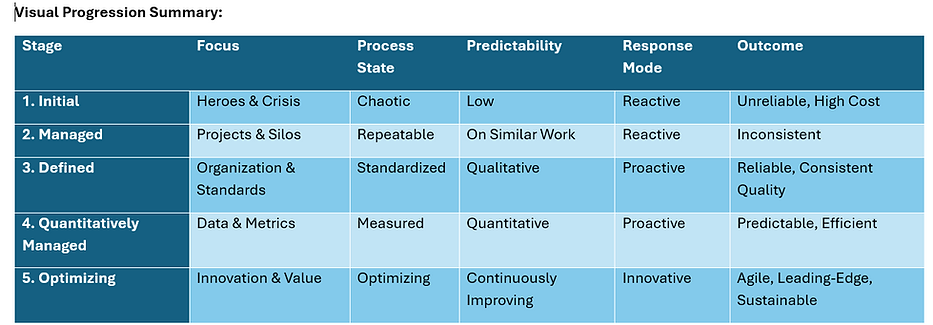
Below is a detailed breakdown of the five classic stages, often adapted from the Capability Maturity Model Integration (CMMI) but applicable to various domains (e.g., sustainability, quality, project management, digital transformation).
The 5-Stage Maturity Model: Detailed Breakdown
Stage 1: Initial (Ad-Hoc / Chaotic)
-
Descriptor: "We react."
-
Key Characteristics:
-
Processes: Unpredictable, poorly controlled, and reactive. Success depends heavily on individual heroics and informal efforts. There are no standardized processes.
-
Approach: Fire-fighting mode. Problems are addressed as they arise, often with panic and rework.
-
Documentation: Little to none. Knowledge resides in individuals' heads.
-
Measurement: No consistent metrics. Performance is unpredictable.
-
Management: Leadership is often unaware of operational issues or intervenes only in crisis.
-
Culture: Blame-oriented, chaotic. High stress and variability in outcomes.
-
-
Example (Sustainability Context): Occasional environmental initiatives happen only due to regulatory pressure or a passionate employee. No strategy or tracking exists.
Stage 2: Managed (Repeatable)
-
Descriptor: "We repeat what works."
-
Key Characteristics:
-
Processes: Basic project management processes are established to track schedule, cost, and functionality. Success can be repeated on similar projects based on prior experience.
-
Approach: Reactive, but with some planning. Lessons learned are informal.
-
Documentation: Basic plans exist for specific projects/initiatives.
-
Measurement: Basic metrics are tracked (e.g., on-time delivery, budget variance), but not used for process improvement.
-
Management: Managers react to problems and require status reporting.
-
Culture: Siloed, but some teams have disciplined practices. Dependent on key individuals.
-
-
Example (Sustainability): A team tracks energy usage manually in a spreadsheet. Recycling programs are established at some sites. Efforts are departmental, not company-wide.
Stage 3: Defined (Standardized)
-
Descriptor: "We have a standard way of working."
-
Key Characteristics:
-
Processes: Standard, documented processes are established and institutionalized across the organization (a "Standard Operating Model"). Processes are proactive and integrated.
-
Approach: Organization-wide standards guide planning and execution. Training is provided on these standards.
-
Documentation: Processes, standards, and procedures are documented and accessible.
-
Measurement: Organization collects process and quality metrics to understand performance.
-
Management: Management proactively reviews process compliance and outcomes.
-
Culture: Process-oriented, collaborative across teams. Focus on consistency and quality.
-
-
Example (Sustainability): A corporate sustainability policy exists. Formal ESG data collection processes are in place. Cross-functional "green teams" meet regularly. Goals are set for waste reduction.
Stage 4: Quantitatively Managed (Measured & Controlled)
-
Descriptor: "We manage with data."
-
Key Characteristics:
-
Processes: Processes are controlled using statistical and quantitative techniques. Performance is predictable because it is measured in detail.
-
Approach: Data-driven decision making. Organization can predict trends and performance within defined limits.
-
Documentation: Detailed performance baselines and models are documented.
-
Measurement: Advanced metrics and statistical analysis are used to understand process variation and root causes.
-
Management: Management uses data to set realistic, quantitative goals and forecast outcomes.
-
Culture: Analytical, fact-based. Focus on efficiency and predictability.
-
-
Example (Sustainability): Advanced analytics predict carbon footprint based on production forecasts. Real-time dashboards track water/energy use against science-based targets. Continuous improvement projects are data-driven (e.g., Six Sigma for waste reduction).
Stage 5: Optimizing (Continuous Improvement)
-
Descriptor: "We continuously improve and innovate."
-
Key Characteristics:
-
Processes: Continuous process improvement is ingrained via incremental refinement and innovative technology/methods. Focus on agility and adaptation.
-
Approach: Proactive identification and prevention of problems. Systematic innovation is pursued to meet changing business goals.
-
Documentation: Knowledge management systems capture and disseminate improvements.
-
Measurement: Metrics are used to drive process innovation and evaluate improvement pilots.
-
Management: Leadership fosters a culture of continuous learning and invests in breakthrough improvements.
-
Culture: Learning organization. Pervasive focus on improvement, agility, and strategic innovation. Failure in pursuit of improvement is seen as a learning opportunity.
-
-
Example (Sustainability): Circular economy principles are embedded in product design. The organization invests in R&D for disruptive green technologies. It influences industry standards, regenerates ecosystems, and views sustainability as a core competitive advantage and innovation driver.
Applying the Maturity Index: Key Considerations
-
Domain-Specific: The OMI is applied to a specific capability (e.g., Sustainability Maturity, Project Management Maturity, Digital Maturity). An organization can be at Stage 4 in project management but Stage 2 in data analytics.
-
Assessment Methodology:
-
Questionnaires: Detailed surveys for leaders and employees.
-
Interviews & Workshops: Deep-dive discussions with key stakeholders.
-
Artifact Review: Analysis of documents, reports, process maps, and system data.
-
Benchmarking: Comparison against industry standards or best practices.
-
-
Maturity is a Journey, Not a Destination: The goal is not necessarily to be at Stage 5 in everything, but to be at the appropriate level for strategic objectives and to consciously manage the progression.
-
Plateaus are Common: Organizations often stall between Stage 2-3 (requiring cultural change to adopt standards) and Stage 4-5 (requiring significant investment in data and innovation culture).